

How To Set Up Sky Watcher Telescope
Table of Contents
In a hurry or only demand a few questions answered regarding the ready upwardly or use of your telescope? Below is a list of links to sections in this Guide. Just find the question that best reflects what you need to know and click it to be taken to that section. Enjoy.
First Time Telescope Users Guide
Congratulations! Yous've purchased your first telescope - an optical time machine that will help you explore our amazing Universe. You may have aspirations of discovering comets or condign a published astro-imager someday; or you might want to simply enjoy views of the moon & planets from time to time. Whatever your astronomy goals, one affair'south for sure: We all must offset at the beginning, and this guide will show you how to employ a telescope. Feel gratuitous to skip to sections that intrigue yous past using the Table of Contents at the terminate of this Guide, or become crazy and read the whole matter!
Before nosotros start, please heed this important warning: Never look at the Lord's day through whatsoever telescope or finder without the proper filtration. It just takes a few seconds to irreparably damage your eyesight - think of how powerful sunlight is when focused through a magnifying glass! Visit the Recommended Accessories department to learn more than about filters for prophylactic solar viewing.
Assembling Your Telescope
This guide assumes you accept put your telescope together according to the manufacturer's directions. Here are a few hints to make that job easier:
- Put your telescope together for the beginning time when you are indoors and take lots of light. Just considering a telescope is normally used during evening hours doesn't hateful you have to ready it up in the nighttime!
- Give yourself enough of room, and gather together a good portion of patience, also as any tools that are required for assembly before you start.
- Once you are finished with assembly, stay indoors and take some time to larn a bit more about its features before y'all have your telescope exterior for the first time.
GET TO KNOW YOUR FIRST TELESCOPE
What Mount Type Do You Accept? How Does Your Telescope Motility?
Earlier nosotros begin, you lot will need to know whether you have a telescope on an alt-azimuth mount or an equatorial mountain. Non sure? Allow'due south figure it out together.
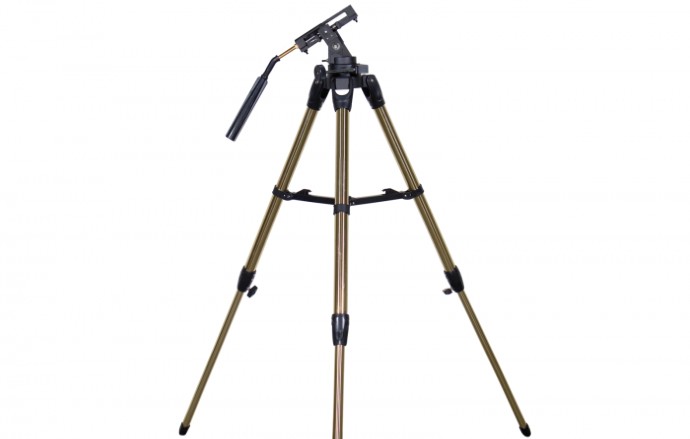
Alt-Azimuth Mount:
If you are similar the millions of people who use a camera tripod, yous are the proud owner of at to the lowest degree one alt-azimuth mount. The tripod legs practice not brand a photographic tripod an alt-azimuth mount, its the "head" that sits on top and how it moves that earns it that distinction. This is the almost common mount used to support and point telescopes, spotting scopes, and cameras.
An Alt-Azimuth mount allows yous to move your telescope in straight lines - up, down, right, and left. In its simplest form, the alt-azimuth mount is completely manual with basic motility controls, like the one shown in the photograph to the left, just it is likewise used on some of the most high-tech telescopes today, and can exist fully computerized with mega bells & whistles.
Store Alt-Azimuth Mounts

Equatorial Mountain:
An easy manner to tell if you have an equatorial mount is to wait for the counterweights. If your telescope mount has i or more than, there's a 98% hazard information technology's an equatorial.
An equatorial mount does not move in direct lines like an alt-azimuth mountain does. Information technology was designed to track the stars as they move in an arc across the heaven. The shape of that arc depends on the latitude you lot are observing from, and an equatorial mount tin exist adjusted to recoup for your location in latitude. Equatorial mounts tin can be very basic or come with a wide range of capabilities and components, from elementary motors on one or both axes, to a total-on computerized system that tin handle observatory-sized telescopes.
Shop Equatorial Mounts
HOW YOUR TELESCOPE MOVES
Practice moving your telescope in the comfort of your well-lit home. Whether y'all have an equatorial or alt-azimuth mountain, positional adjustments are made in a like style.
Non-Computerized Telescope Mounts:
Outset by loosening the lock knobs on the altitude & azimuth (for alt-azimuth mounts) or right ascent & declination axes (for equatorial mounts), then grasp the optical tube, push or pull it in the direction yous wish to get, then re-lock to keep your telescope from moving on its own. This method is used to brand big, sweeping movements across the sky. To make smaller, more than incremental movements, manual mounts will take either one or two "slow motion command" cables or knobs. Using the slow move control function of your telescope works great to go along objects in the field of view of your eyepiece, or to null in on an object once you lot are very close.
Computerized "Go To" Telescopes:
Apply the included hand controller to motility your computerized telescope. Choose the speed, or slew rate, based on how far you lot need to move the telescope across the sky. Faster speeds are used to move from i object to another, and slower speeds are used to center the object or proceed it in your eyepiece. Accept some time to try out these speeds and experiment with the directional buttons on the manus controller.
Depending on the model, your "GoTo" telescope may allow you to brand manual movements as well as those achieved by your hand controller, but make sure and check your educational activity manual first. Making manual movements on a computerized telescope can sometimes cause it to "lose its identify" in the sky, requiring that you exercise a 2nd alignment procedure if you want to accept reward of its "Go To" electronics.
UNDERSTANDING TELESCOPE EYEPIECES & BARLOWS LENSES
At present that you have practiced moving your telescope, its time to accept a look at some of the accessories that came with it. Regardless of the telescope you purchased, you lot should have received at to the lowest degree one eyepiece, and it is the nigh important accessory in the box. A telescope'southward job is to gather and concentrate the low-cal emitted past angelic objects into a point. An eyepiece's job is to take that concentrated light and brandish the resulting image for you to savour. Just similar telescopes, eyepieces come in a wide range of styles, sizes, and focal lengths.
For the purposes of this guide, y'all demand to understand just i thing near your eyepiece: What the Numbers Etched on the Eyepiece Mean?

Officially, the numbers stand for the "focal length" of the eyepiece. For the moment, all we care most is what that translates to as far equally magnification goes. In other words, how do you choose the eyepiece that will give yous a higher or lower power view?
The rule of thumb is the opposite from what you'd retrieve…the higher the number on the eyepiece, the lower the resulting power, or magnification, you will achieve on your telescope. For instance, let's say you have two eyepieces, and their focal lengths are 25 mm and x mm. If I asked yous to choice your lowest power eyepiece for a job, y'all should know right abroad that I am talking about your 25 mm eyepiece. There are lots of things one can learn most eyepieces to heighten your enjoyment of astronomy, but for right at present, that'due south all you lot need to know:
High numbers = low powers
Low numbers = high powers
What'south A Barlow Lens
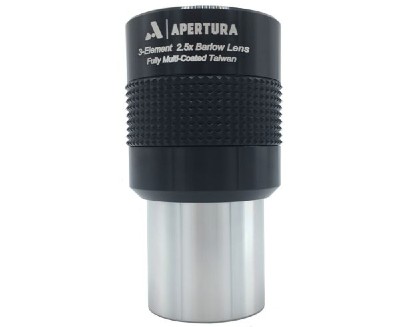
Some telescope packages come with a Barlow lens, or you lot may have purchased one as an accessory for your telescope. A Barlow (capitalized because it's inventor is Peter Barlow) does not work on its own, only works in conjunction with an eyepiece to multiply the magnification of that eyepiece by a factor of ii or more times. Nearly Barlows on the market place today multiply by 2X, and information technology will be marked on the barrel of the Barlow just similar the focal length is marked on an eyepiece. This means that if you have an eyepiece that provides 100X magnification through your telescope, that same eyepiece in the Barlow would magnify an object past 200X.
Barlows are a super economic way to increment the number of magnifications you lot have available. For instance, three eyepieces and a Barlow lens would requite yous six different magnifications. To utilise a Barlow, insert it into your focuser or diagonal merely as you would an eyepiece, and so insert your choice of eyepiece into the open finish of the Barlow and tighten the thumbscrew.
The best Barlow lens at the lowest price are bachelor from Apertura!
Adjustment & USING YOUR TELESCOPE'South FINDER
So far, you have assembled your telescope, yous accept practiced moving information technology around, either manually, electronically, or both, and you have figured out which eyepieces are for lower powers or higher powers. Next, nosotros are going to align your finderscope, and trust me, this simple step can either make or break your first observing session, so do not skip alee!
Finders are an important telescope accessory, considering they literally do what their name implies: finders help you notice things! Without a finder on your telescope, yous will spend most of your time trying to detect objects instead of looking at them. Even the Moon, which seems like a slam douse, can be hard to observe without the help of a finder. It is also easy to upgrade your telescope'southward finder at any time if y'all discover that you prefer i over the other.
Your telescope virtually likely came with 1 of two finder types: a "red dot finder", or an "optical finder".
An optical finder is a minor telescope that is held onto the acme of the main telescope with a finder bracket. Information technology offers a depression magnification view of the sky, ordinarily anywhere from 6X - 10X, and when you look through the eyepiece, you will see a crosshair to assistance you center the object in the finder'south field of view.
Most optical finders can be focused by either turning the eyepiece itself or a focusing ring that wraps effectually the bore of the barrel.
Finderscopes can either be "straight-through", as shown in the photo to the left, or correct-angle, assuasive the user to look down to come across through the finder rather than positioning your eye behind the finder in a line-of-sight manner.
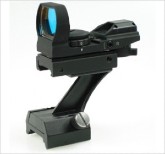
A ruby dot finder displays a broad field, aught magnification view of the heaven. Instead of looking through an eyepiece, the user looks at a glass or plastic screen that a red dot, or in some designs, a bull's eye, is reflected onto. This illuminated point is adjustable, both in brightness and in its placement on the screen.
Unlike standard optical finders, a Red Dot Finder needs a battery to operate, and almost of the fourth dimension, it is included. If your red dot finder doesn't illuminate, make sure and check that the battery doesn't take a slice of moving-picture show or other barrier between the battery and the contact betoken. This film keeps your bombardment from running down betwixt the fourth dimension information technology leaves the manufacturer and arrives at your domicile. Another way to reach this is to plow the battery upside down.
Red Dot Finders normally attach to a telescope by means of an elevated bracket. This added height makes it easier for the user to look through the finder.
Both telescope finder types piece of work well, but they must be aligned to the telescope or they will be worthless. Check out your particular finder and make note of the adjustment knobs. They will either be on the carmine dot finder body itself or, if you have an optical finder, you will use the thumbscrews that append the finder in the bracket. Now, we are going to align your finder:
- Install the finder bracket and finder on your telescope every bit directed in the instruction manual.
- Choose the everyman magnification eyepiece you have available and put it in your focuser (if you have a Newtonian reflector) or diagonal (if you have a refractor, Schmidt-Cassegrain, Maksutov-Cassegrain, or other catadioptric mode telescope).
- Accept your telescope outside during the twenty-four hour period and put it in a location that gives you a view of a stationary object that is a good altitude abroad. A finish sign, lamp postal service, or a high voltage insulator atop an electrical pole all make good candidates, but don't stress about it, just choice something that doesn't move and is as far away as possible.
- Manually point your telescope as best you can at the target, and then look through the eyepiece. Hopefully, the object volition be in the field of view, only if information technology isn't, employ the slow motion control knobs or dials on your telescope's mount to brand adjustments until the target is in the center of the eyepiece. Tighten the lock knobs on the telescope and then it won't move.
- Now, while looking through the finder, apply the adjustment knobs on the finder or finder bracket to eye your target as precisely as possible in the finder'due south field of view.
- Cheque the view through the main eyepiece once again. If the object is still centered in the field, and you lot have a second eyepiece or Barlow available, and so you can motility onto the next step, otherwise make adjustments until you are successful. If you lot just accept one eyepiece, you are finished aligning your finder for at present, and can skip to the next section.
- With your telescope locked downwardly, advisedly change your eyepiece to the adjacent highest magnification or add a Barlow to the electric current eyepiece to double the magnification (run into "Understanding Eyepieces" if you need a refresher on this topic). Follow steps 4 & v over again to further tweak the precision of your finderscope alignment.
- When the target is centered in both your finder AND your eyepiece at the highest magnification yous have available, your finderscope is officially aligned! We will tweak information technology further once we are out nether the stars, only for now, your telescope is gear up to trip the light fantastic!
Before YOU Get-go OBSERVING
The equipment that you will utilise to detect the night heaven is merely one office of the equation for a successful evening of exploration. There are a few key questions you need to ask yourself before you caput out, and a few accessories that we recommend y'all gather together that will help drag your enjoyment and success.
How Will You Find Celestial Objects?
It's a large Universe out there, then before you hop on the Galactic Highway, you might desire to take some fourth dimension to consider what you will use for directions. Does your "vehicle" take a congenital-in navigation system, or are yous dependent upon maps from AAA? Either style, yous take choices, so let's get to information technology:
Non-Computerized Telescopes: People have been using non-computerized telescopes for hundreds of years, and they have enjoyed finding and viewing thousands of celestial objects. There are several ways to find objects without the assistance of automated GoTo, from unproblematic "star-hopping" to using an equatorial mount's setting circles. Here are a few of the most common options for finding objects:
Naked Eye Astronomy
A time-honored, although limited, style to find the universe! Here's how it works: You look up, discover something of interest in the sky, and bespeak your telescope at it. Done. This strategy works for the Moon, visible planets, and really bright deep-sky objects like the Pleiades, the Orion Nebula, the Great Cluster in Hercules, and from darker locations, the Andromeda Galaxy. The downside, however, is the great bulk of celestial objects are not hands seen with the naked center, and so, sooner or later, yous volition want to selection up ane or more than of the following star guides:
Planispheres
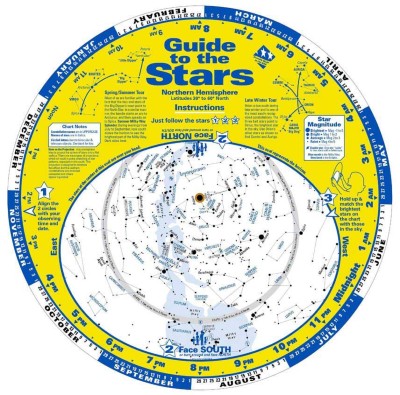
This inexpensive, unproblematic disc displays the night sky for a range of latitudes, including the constellations and more than prominent celestial objects. By adjustment the date with the time, yous can apace see which constellations are going to be upward at any given moment.
If yous have a planisphere, you can "star hop" to the more popular galaxies, nebulae, and star clusters that are marked on the chart. After lining upwards the correct engagement and time, orient yourself by holding up the planisphere and matching the nautical chart with what y'all see in the sky. Once you observe a few of the brighter stars, visually "hop" to the next star, and the side by side, until you lot observe the general location of the object you wish to see, then find that indicate in your finderscope, and if you've aligned it correctly, the object y'all star-hopped to should be in your eyepiece. Voila!
High Bespeak highly recommends a planisphere or a star chart with planisphere for anyone who is interested in observing the night sky, whether you have a telescope or not! Learning the constellations definitely enriches your experience in astronomy; information technology makes you feel more than connected to the earth around you, and expands your view. That is an important office of what astronomy is all about.
Planisphere Recommendations:
Star Charts & Atlases
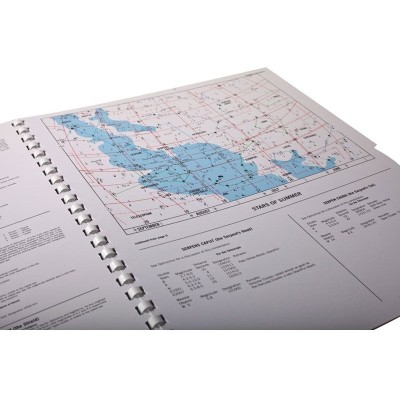
A skillful star nautical chart or atlas of the night sky has been the amateur astronomer's Bible for decades. Some of them are in book form, and others are laminated charts in binders that allow each chart to lay apartment, only regardless of their way, star charts have ane matter in common…they depict areas of the night sky in detail.
Earthly maps accept latitude and longitude marked on them and so that those with training in surveying, navigation, etc. can find any point by locating those coordinates. Angelic maps, star charts, and atlases are very similar in that they are printed with the equivalent of longitude and latitude (right ascension & declination) so that astronomers and celestial navigators tin can find their fashion.
Utilise these maps to star-hop to an object, or dial in the celestial coordinates of that object with your equatorial telescope'south setting circles. Learning how to apply setting circles takes do, but the results are worth it!
Star Nautical chart Recommendations:
Apps for Smart Devices
If you lot have a smart device, such as an iPhone, iPad, or Android phone or tablet, there are several apps available for observational astronomy. Some apps volition fifty-fifty tell you which celestial object y'all are looking at when you point your device at it! The apps listed beneath are just a sampling of what is available, and of course there are new apps being adult all the time.
A Few Available Apps:
Planetarium Software

An astronomy software program is a fun way to larn more than about the Universe. Even the almost inexpensive programs allow you to bring upward a view of your local night sky for whatsoever date or fourth dimension combination. Click a button to accept the plan bear witness you where the planets are, or brandish the outlines of the constellations so y'all can get your bearings.
Once you accept the chart looking the way you similar, print it out, and now you accept a blueprint of the sky for your latitude, at the exact date and fourth dimension you will be outdoors with your telescope. This feat barely scratches the surface of what today's planetarium software can do, and at that place are several programs to choose from for both Mac & PC operating systems.
Software Recommendations:
Computerized Telescopes
This is pretty easy, because computerized telescopes have a built-in navigation organisation. Not only can they align themselves with trivial help from yous, they have a congenital-in database and drive organisation that can evidence you thousands of objects with the button of a few buttons.
If you take a computerized, "GoTo" telescope, yous may not feel you lot need anything more, but nosotros recommend you consider a planisphere or some planetarium software so that you can learn the constellations, print out a detailed star chart for your evening'southward observations, and farther enrich your astronomy experience.
Buy or Brand a Cherry-red Flashlight
Artificial lite is the enemy of amateur astronomers. When yous are out observing faint celestial objects, you demand your eyes to perform at their best, and that tin can but be accomplished when your pupils are as dilated as possible. Our pupils dilate to let united states of america to see ameliorate in the dark, and any white light that interferes with that procedure also interferes with our power to come across item in those beautiful, ethereal galaxies and other deep-heaven objects. However, nosotros are still human and we need to be safe whilst traipsing around in the dark! Enter the carmine flashlight.
Red lite doesn't interfere with the dark adaptation of our optics, and then you volition discover that about every apprentice astronomer you know will take one hanging effectually their neck or banging effectually in their pocket. You need a crimson flashlight, too. You can either buy a red flashlight, or make i.
Red Flashlight Recommendations:
To make a ruby flashlight, you'll demand a regular white flashlight, some red rubylith (available at artist'southward supply stores), and some pair of scissors. Unscrew the head of the flashlight and remove the glass covering the bulb. Trace around the glass onto the rubylith, and using your scissors, cutting out a red circumvolve. Then simply reinstall the glass, followed past the red moving-picture show, and screw everything together. Badda-bing; a cherry flashlight!
Yous tin can also utilise red electrical tape in a pinch; just wrap it around the head of the white flashlight. Red electric tape also works wonders for interior car lights and other offensive white low-cal, just so does rubylith! In fact rubylith can be cut to fit the top of your iPhone, or your computer screen…the possibilities are endless!
Picking a Place to Find
Where you identify your telescope when observing is dependent upon your unique situation, but if you take a option, follow these suggestions:
- Notice a level or near level spot
- Cull grass or dirt whenever possible
- Stay away from decks or other elevated surfaces. They vibrate when you walk on them and will shake your telescope and therefore, the prototype.
- Concrete or asphalt is okay, just if information technology has been warm outside, it will accept awhile earlier the surface stops radiating rut, which distorts the air and therefore, the paradigm.
- Try to stay abroad from sources of light. Plow off your porch lights, and if you are friendly with your neighbors, ask them to turn theirs off every bit well, and so come share the view through your telescope! If yous live in a light polluted location, welcome to the situation faced by millions of amateur astronomers! Take eye that Los Angeles has a very large population of telescope enthusiasts. The point here is to choose the darkest location possible for your situation, and then bask the views!
- Finally, pick a location with the widest view of the sky you can discover. In wooded areas and those with lots of tall buildings, this tin be a claiming, just merely like the whole calorie-free pollution thing, the idea is to choose the best your state of affairs has to offering.
Check Out Your Seeing Weather
Why do you care what the seeing weather condition are like? As long equally it'south not totally cloudy, snowing, or raining, and then what, right?
You will be amazed at how quickly seeing conditions change, and what event they accept on observations! The sky may exist perfectly articulate, but seeing can be so bad that Jupiter or Saturn might expect similar they are under water, and fifty-fifty low magnification views are not in focus. The next night (or the next hr!) those aforementioned planets will look perfectly focused in your highest magnification eyepiece, and all considering the seeing atmospheric condition improved.
One of the biggest mistakes new apprentice astronomers make is assuming that focus will be sharp on any subject, with any eyepiece, on any nighttime. Understanding that seeing atmospheric condition can support high magnification views one moment and crusade an unfocused mess the next will help yous become the nearly out of your telescope and accessories, and lower your claret force per unit area! Before yous set up your telescope for a night of observing, arrive the habit of taking a few moments to look upwards and bank check weather condition:
- Are the skies clear or are in that location passing clouds? Knowing there are clouds in the surface area helps you sympathize why an object you are gazing at suddenly disappears, or your GoTo telescope insists an object is there but yous can't meet it!
- Are the stars twinkling? If so, are they steady overhead, or do they twinkle from horizon to horizon? Nigh of the time, stars overhead are steady and the twinkling increases equally you motion towards the horizon due to the increased temper. If stars are twinkling overhead, you have "poor seeing", but if they are steady near to the horizon, then grab your scope and get fix, because the seeing is peculiarly good, and who knows how long it will terminal!
- Is information technology peculiarly humid out? Is dew already forming on surfaces? Dew is not a deal-breaker unless it gets so heavy that all of your optics are affected, but knowing whether it'southward going to exist a dewy dark will aid you plan your accessories. We'll talk more virtually dew prevention in the "recommended accessories" section beneath.
- Is it windy? A slight breeze can assist go along dew at bay, but also much air current can degrade seeing atmospheric condition and brand observing uncomfortable.
Commencement OBSERVING!
Collect Your Telescope Gear: Whether you are driving to a nighttime-sky location or are observing in your back grand, it makes sense to make sure you collect everything you will demand for an evening under the stars before you caput outside. Some people find it works all-time to make a list and continue it nigh your telescope. Others keep everything they need in accessory cases for quick and like shooting fish in a barrel admission. Whichever organizational method yous cull, go along in listen that it is better to bring everything out at one time than to keep going back into the house and subjecting your optics to white light, or worse yet, not accept what you need when you are miles away from home. Don't forget your red flashlight, remember to bring extra batteries, and pack some coffee or hot cocoa while you're at it!
Level Your Tripod: If you lot've picked a relatively flat observing location, this should exist pretty easy. Suit your tripod legs until the tripod looks as level as possible. This is usually exact enough for basic visual astronomy, just you lot may want to increment the precision with a bubble level.
Align Your Telescope: The method used for telescope alignment depends on the type of mount you have and whether it is computerized or not. If you have a non-computerized alt-az mount, yous can fix your telescope down so that it points in any direction. If you accept a non-computerized equatorial mount, you will want to fix the telescope on the ground and then that the polar axis is pointing northward, and then follow the instructions in your manual to polar align your telescope. To find North, yous tin use a compass or navigational device, or larn how to find the N Star (Polaris) visually. The alignment method used for computerized telescopes varies by manufacturer and by telescope serial. Follow the instructions in your transmission to input the required data in your hand controller, and to align your telescope so it will accurately find objects for you.
Tweak Your Finder: If y'all followed the instructions in the Aligning & Using Your Finder section of this guide, your finderscope should need only the slightest adjustments to its alignment. Insert your lowest powered eyepiece and and then bespeak your finder at the largest object in the sky (other than the Sunday, of course). This may exist the Moon, or it may be Jupiter, or it may be a bright star. Center it in your eyepiece's field of view as best you tin, and and then look through your finder and make whatsoever adjustments necessary to cause the object to be centered in the crosshairs. If you desire greater precision, switch eyepieces and do the same affair at higher magnification.
This quick procedure should be washed before you lot outset whatsoever observing session, and normally information technology volition take just a few seconds. Even so, if you accidentally bumped your finder or turned the adjustment knob by mistake, you may need to re-marshal your finder. This happens to anybody sooner or afterward, merely you will get really skilful at it and even a major re-alignment will be a piece of cake.
Use Your Lowest Power Eyepiece Whenever Y'all First Observing, Regardless of the Object: Starting at depression magnification accomplishes a couple of things. First, it tells y'all a lot well-nigh your seeing atmospheric condition. If you look at Saturn with a 30 mm eyepiece and it is "pond" in the atmosphere, you know right away that you lot won't be able to use a higher magnification eyepiece until conditions improve. Another reason for starting with the everyman power eyepiece has to practise with the ease or difficulty of finding an object in the sky. This is true whether you are using a computerized telescope or not. It is way easier to discover and center an object if you are searching for information technology in a wider swath of sky. The more magnification you utilise, the less celestial real estate you lot will see, and the more precise you volition have to exist to get your target into the field of the eyepiece. Then, practise yourself a favor and start with a depression power eyepiece.
Retrieve to Focus: All telescopes have a focuser, and whenever you lot walk up to a telescope's eyepiece, whether information technology is your telescope or someone else'due south, you should focus the image and so that it looks as sharp as possible. Remember, everyone's eyes are different, and "almost" in focus isn't good plenty. Yous will miss subtle details with an out of focus image, so the outset thing you should do after inserting an eyepiece into a focuser or diagonal is focus. Remind your guests to focus for their eyes, too…they will relish the experience way more if you do. By the way, sometimes focus is hard to accomplish, especially at higher magnifications or during less-than-stellar seeing weather condition. When this is the case, the best way to focus is to slowly adjust the focuser until you lot experience that you take just passed best focus, so back up to the sweet spot. If you cannot focus, you are trying to observe at a magnification that the image cannot support due to the limitations of the telescope or the seeing conditions. The all-time course of action when this happens is to remove that eyepiece and utilize something with less power.
Changing Magnification: When y'all are set up to wait at an object at college or lower magnification, it is time to change eyepieces or add a Barlow. Before you remove the eyepiece you are currently using, take a second and center the object in the field of view outset. At present carefully loosen the thumbscrew holding the eyepiece in place, slide information technology out, and insert the new eyepiece. Remember to tighten the thumbscrew deeply so that your eyepiece volition non fall out when you move the telescope. You may demand to re-focus for the new eyepiece. Some eyepiece sets are "parfocal" which means the manufacturer designed them to have piffling or no alter in focus between eyepieces in a series, merely nearly of the fourth dimension, you volition accept different styles and models of eyepieces, and so re-focusing will near certainly exist required. Most apprentice astronomers accept several eyepieces at their disposal. An boilerplate eyepiece count is between 3 & v, with a Barlow thrown in for good measure. Extra eyepieces permit you to adjust the magnification to the evening'southward seeing conditions, also as match the magnification or field of view to the object.
Computing Ability: To figure out how much magnification an eyepiece provides for a given telescope, divide the focal length of the eyepiece into the focal length of the telescope. For instance, a telescope with 1000 mm focal length will yield 100X magnification with a x mm eyepiece. Use this formula when shopping for your next eyepiece. Bank check it out:
-
Permit's use the example of the yard mm focal length telescope, and then allow's say you have a thirty mm eyepiece (33X), a x mm eyepiece (100X) and a 2X Barlow, which would give y'all 66X with the xxx mm eyepiece and 200X with the x mm eyepiece. Since you know that you accept iv magnification choices (33X, 66X 100X & 200X), you might desire to buy something that solitary, would give you about 150X, and doubled, 300X. That would be either a half-dozen mm eyepiece (167X & 333X) or a 7 mm (143X & 286X). The thought is to fill in gaps in magnification without going besides high.
-
How Much is Too Much? Wait, what do you lot mean, too loftier? Sad, but World-based telescopes accept their limits. We have this pesky thing called the atmosphere, and it isn't completely transparent, even though we humans tend to recall so until we try looking through it with a telescope. This is why space telescopes are then of import; they don't take the atmosphere to deal with and tin provide much clearer pictures of the Universe.
-
The bones formula for the limits of magnification on a given telescope has to do with its aperture. The larger the eyes are on a telescope, the more magnification it tin can handle…to a point. That point depends on, you guessed it, seeing weather. That is why astronomers build big telescopes on the tops of mountains out in the middle of nowhere because those locations have a topography that tends to produce better seeing.
-
Here's the rule for max magnification: Approximately 50X per inch of discontinuity. That means a 4" telescope will max out at about 200X, and an 8" telescope will max out at about 400X. These rules are super variable, however. Sometimes the seeing is so good a 4" telescope can easily practice 400X, etc., so what's a person to do if they want to figure out what their telescope can really handle?
-
Get out at that place and find, and while y'all are enjoying the wonders of our Universe, pay attention. If you lot do, you lot will figure out apace enough what seeing conditions tend to be in your area, and what kinds of magnifications the combination of your telescope and your location will support. If yous have an eyepiece that gives you 200X, and when you lot put information technology in the Barlow you can merely achieve focus about 50% of the time, so you will know that while 400X is doable, 500X will be way less likely, and you might not desire to spend a good deal of coin on an eyepiece that gives you that much magnification.
-
We also recommend you find a local astronomy club near you and plan to attend a star party. It may non exist your loving cup of tea, but you should cheque information technology out and see. Besides the social aspect, a groovy benefit of observing in a group is the ability to endeavour other people's accessories on your telescope, or at least see how well you similar them on someone else's telescope! Also, if you accept questions or problems with your telescope, there's a good chance someone is nearby that tin can aid you.
WHAT TELESCOPE ACCESSORIES Exercise I Really NEED?
There are literally hundreds of accessories available to the amateur astronomer today, and equally you get more experienced with your telescope, you will observe for yourself which ones are needed most. Notwithstanding, in that location are some accessories that pretty much everyone volition stop upwards buying equally before long as they are able, and those are the ones we will concentrate on here. We already talked most Barlows and a red flashlight, and those items are right up there at the top of the listing, including:
Actress Telescope Eyepieces: Like we said earlier, a good eyepiece count is between iii & 5. Everyone should have what they consider a low, medium & high power eyepiece, and then add more than as you lot wish. You can spend as fiddling equally $30 for an eyepiece or as much as a grand or more. We propose you spend as much as you tin can beget, because the views will only be as good as the weakest signal in your optical chain. Other considerations when buying eyepieces are field of view (wider fields are necessary on some very big deep-heaven objects), and eye relief (how close your eye must come to the glass to achieve focus). Those who wear eyeglasses need more than eye relief than those who don't.
Recommendations: Which eyepieces yous require depends on many factors, including your telescope, what kind of observing you like to practice, and your budget. To shop for an eyepiece, figure out what focal length you want, and then filter from there by price, field of view, barrel size, and manufacturer. In the following link we accept ordered eyepieces by price…you tin can have it from there. If y'all need whatsoever help, yous can e'er contact us and we will be glad to walk you through. At present, here's that link: Telescope Eyepieces Filtered past Price.
Dew Prevention Devices: Most amateur astronomers will exist assaulted by dew at some point, and many deal with it on a regular ground. Dew tin form on your telescope optics and shut downward an observing session if it is not dealt with. Dew besides coats eyepieces, filters, and other surfaces. The closer your telescope's optics are to the tube opening the more likely y'all will have dew. The worst telescopes for dew are those with corrector plates. Schmidt-Cassegrains and Maksutov-Cassegrains are two examples of telescopes with a piece of drinking glass most the opening of the tube associates. Refractors have their optics near the front, but are usually ready back a piffling bit by virtue of a built-in dew shield. If you accept a Newtonian telescope, y'all will non have to bargain with dew on your mirror, since the telescope tube naturally creates a giant "dew shield", but y'all volition yet get dew on your eyepieces and finder if not prevented.
Here are a Few Options for Dealing with Dew on Your Telescope'due south Optics:
This guide assumes you take put your telescope together according to the manufacturer'due south directions. Here are a few hints to make that job easier:
- Dew Shield: These optical tube extensions fit over the front end end of the telescope and delay the ability for dew to form on the optics. You can buy flexible dew shields that wrap around your telescope's outer diameter and will lie apartment when not in use, or flexible heated dew shields that will raise the dew betoken of the surface to keep dew abroad. Choose a dew shield that is made to fit your telescope, or measure the outside diameter of the telescope and purchase co-ordinate to those dimensions.
- Dew Strips: Dew heaters, or dew strips, are thin strips of a thick fabric that have heater elements running forth their length. They wrap around the outer virtually border of the telescope tube, stay put thanks to Velcro, and plug into a hand controller, which allows you to adjust the amount of heat applied to the surface. Dew Controllers often are capable of handling more than one heater, so you lot can accept one for your telescope, one for your finder, or whatsoever other number of accessories. Continue in mind that dew heaters and their controllers require DC ability, so when because them, remember about how they will exist powered.
- Pilus Dryer: Many people use a pilus dryer to blow away the dew. If y'all cull this method, keep in mind that you always desire to use the To the lowest degree amount of heat required to do the job. Overheating your mirror will only crusade distortions of your image until the drinking glass returns to ambient, and then the blow dryer is needed again. This is why most people use heater strips made for the purpose. They tin be fix to provide but enough heat to do the job, and only effectually the perimeter of the mirror, limiting the corporeality of estrus distortion they cause.
An Alternating Grade of Powering Your Telescope:
Most telescopes volition run on more than than one blazon of ability, assuming information technology is powered in the first place! If your telescope runs on household batteries, only volition accept an Ac or DC ability adapter, we highly recommend you selection 1 or both of them upwards! An Air conditioning adapter volition let you run your telescope off of a regular wall outlet. This is groovy for those who notice close to the house or garage, and is fashion better than using up a boatload of AA batteries! A DC ability adapter comes with a cigarette lighter plug, and can run your telescope off of your car battery if you drive to your observing site, or from a portable DC battery. These DC battery packs tin can sit right under your tripod legs and, if charged up before you become, volition run your telescope all night long. They can also run your dew heater straps, heated dew shield, or other DC powered accessories.
Recommended Power Accessories:
Moon Filter:
The moon is amazingly vivid, and casts a blinding light when observed with a telescope. A elementary moon filter, also chosen a neutral density filter, will allow yous to gaze at the Moon and still run across all the subtle details of the lunar surface. A moon filter is inexpensive, and screws onto the barrel of standard telescope eyepieces. If you have ane.25" butt eyepieces, then buy a one.25" Moon Filter. There are also 2" moon filters available for larger barreled two" eyepieces.
Recommended Moon Filters
Telescope Instance and/or Cover:
A telescope example will protect your investment when you are transporting information technology to a dark heaven site or storing it in your garage or closet. Some telescope models have hard cases bachelor, but near volition fit into a soft-sided example that is fabricated for a range of telescope sizes. A soft case is sufficient unless you plan to travel by air and desire to accept your telescope with you. In these instances, a hard case is your best bet. There are also protective covers available for all sizes of telescopes. Some telescope covers are made of cogitating fabric on one side and so that you tin can leave your telescope set up during the solar day so just remove the embrace to start observing in the evening. The reflective material helps reflect the sunlight to keep the telescope from getting hot. In that location are also covers made from a heavy-duty textile that can handle more extended times out in the elements. Choose a good cover, and pick the right fabric for your observing habits.
Solar Filter:
At the very beginning of this Guide you lot were warned almost looking at the Dominicus, even for a few seconds, without the proper filtration. There are condom solar filters on the market today, and they are non very expensive. White Lite Solar Filters are made from a special textile that filters out all the dissentious effects of the Sun and lets you observe features on the Dominicus safely. To use a safe solar filter, buy the correct size for your telescope and fit it snugly over the front end of your optical tube. The filter jail cell is threaded with thumbscrews that can be tightened to make sure the filter stays put. With this filter in identify, yous can see sunspots and lookout solar eclipses in comfort. At that place are also filters bachelor that volition let you to encounter other solar details, like prominences and flares, just they are more than expensive than standard white low-cal solar filters. If yous bask viewing the Sun, yous may want to await into more advanced H-Alpha solar filters. After all, observing our Dominicus allows yous to become a shut-up and personal view of a star, and that's pretty cool!
Telescope Accompaniment Bundles:
Earlier we say "The Finish" to the First Time Telescope User's Guide, we wanted to tell you about an piece of cake and inexpensive style to accumulate some of the most important accessories for your telescope. High Point Scientific has put together Accessory Bundles for some of the nearly popular telescopes available today. If you take i of the telescopes listed below, check out their bundles! They include items like extra eyepieces, ability supplies, Barlows, motor drives for telescopes with equatorial mounts, and much more.
Just The Outset
This may exist the end of this Guide, but information technology is just the starting time of your adventures in astronomy! Nosotros hope nosotros accept helped clarify some of the questions most new astronomers normally have, and that we take made your first observing sessions more of a success. If yous take whatsoever questions, or demand assist choosing products for the next stage of your journey, please experience free to requite united states a call, first a conversation, or send u.s. an email anytime.
Clear Skies,
The Staff at High Point Scientific

How To Set Up Sky Watcher Telescope,
Source: https://www.highpointscientific.com/astronomy-hub/post/astronomy-101/beginners-guide-to-using-a-telescope
Posted by: allenwomand.blogspot.com
0 Response to "How To Set Up Sky Watcher Telescope"
Post a Comment